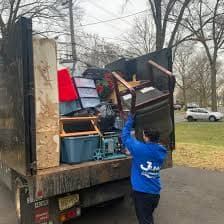
Cleanout projects — estate cleanouts, major renovations, downsizing moves — often involve a roll-off dumpster on the driveway for 3–7 days or longer. The dumpster arrives empty and light, but by day 3 it's carrying tons of debris while sitting on a small footprint of steel feet. That's when driveway damage happens.
How dumpster damage actually occurs
- Point-load stress. A loaded roll-off distributes its 20,000–40,000 pounds across four steel feet the size of a laptop. That's easily 5,000 pounds per square inch of contact — enough to crush concrete if the slab isn't reinforced.
- Sustained load creep. Concrete slowly deforms under constant load ("creep"). A dumpster sitting for a week does damage that a truck passing over for 30 seconds wouldn't.
- Heat + weight combined. On hot summer pavement, concrete is more compliant. Dumpster feet leave imprints that don't rebound.
- Sliding on delivery/pickup. Roll-offs are dragged onto and off the driveway on their steel rails — this scrapes and stresses the surface at the drop and pickup points.
The wood blocking rule
The single biggest protection: require wood blocking under all four dumpster feet. Two 2x8 boards under each foot spread the load across roughly 100 square inches instead of 4 — reducing point pressure by 25x.
The Solid Waste Association of North America publishes placement standards for roll-off containers that include load-spreading blocking under feet as best practice — quality haulers do this by default.
Protective mats and pads
For longer-duration rentals or driveways that are already showing wear, plastic composite ground mats (used on construction sites) can be laid under the entire dumpster footprint. More expensive but full protection.
Position matters
Place the dumpster on the strongest section of the driveway — usually the middle of the pad, away from edges. Edges are unsupported and fail first under load. Never place a dumpster on a driveway seam or expansion joint.
The Portland Cement Association classifies edge and joint failure as the most common form of driveway distress under above-normal loads — usually preventable with proper placement.
Damage that shows up after pickup
Some dumpster damage isn't visible until after the container is gone. Look for:
- Foot-shaped depressions where the dumpster sat
- Cracks radiating from the foot positions
- Scrape marks in a line at the pickup/drop path
- Surface pitting or spall at edges
If damage does occur, Local Concrete Contractor's driveway cost breakdown covers what repair vs. resurface vs. full replacement typically runs — useful for evaluating an insurance claim against the removal company or planning your own repair.
Insurance and documentation
Before delivery: take photos of the driveway from multiple angles. Note existing cracks, wear, and dimensions. If damage occurs, before/after documentation is the deciding factor in any insurance claim.
The National Waste & Recycling Association publishes best practices for member haulers that include property protection standards — a hauler affiliated with NWRA has committed to those standards.
Alternative placement options
If your driveway is questionable, consider:
- Yard placement (with clearance from irrigation, sprinkler heads)
- Curbside with a street permit
- Rental gravel pad delivered by the hauler for the duration
- Shorter rental period (dumpster swaps instead of longer rentals)
Hazardous materials
Federal regulations from the U.S. EPA hazardous waste program restrict what can go in a residential dumpster. Paint, chemicals, batteries, and electronics need separate disposal — trying to hide them in a roll-off can trigger fines and pickup refusals, which extends the rental and increases driveway exposure.
Careful placement, proper blocking, and short rental periods protect a driveway through even the biggest cleanout project. Cut corners on any of those and you're paying twice — once for the cleanout, once for the driveway repair.
The U.S. Occupational Safety and Health Administration publishes safety and load-management guidelines for containerized waste operations that quality haulers follow as baseline practice.
Pineville Junk Removal Team
Our expert team has been serving Pineville and surrounding areas for over 12+ years, completing 500++ projects. We share our industry knowledge to help homeowners make informed decisions.